
In the fast-paced world of modern warehousing and international logistics, time is the most expensive commodity. Traditionally, the process of moving goods and weighing them were two distinct operational steps. A worker would haul a pallet to a stationary floor scale, wait for the readout, log the data, and then move it to the loading dock. This “double handling” is a silent killer of productivity. The emergence of the pallet truck with an integrated weighing scale has fundamentally rewritten this workflow, merging transport and measurement into a single, seamless motion.
Understanding the mechanics of a weighing pallet jack requires looking beyond simple hydraulics. These machines are precision instruments designed to thrive in rugged environments. By embedding load cells directly into the forks, manufacturers have enabled real-time data collection. For a business owner looking to optimize a B2B export operation or manage a bustling distribution center, this technology is no longer a luxury—it is a baseline requirement for maintaining competitive margins and ensuring shipping accuracy.
The Technical Evolution of Industrial Weighing Solutions
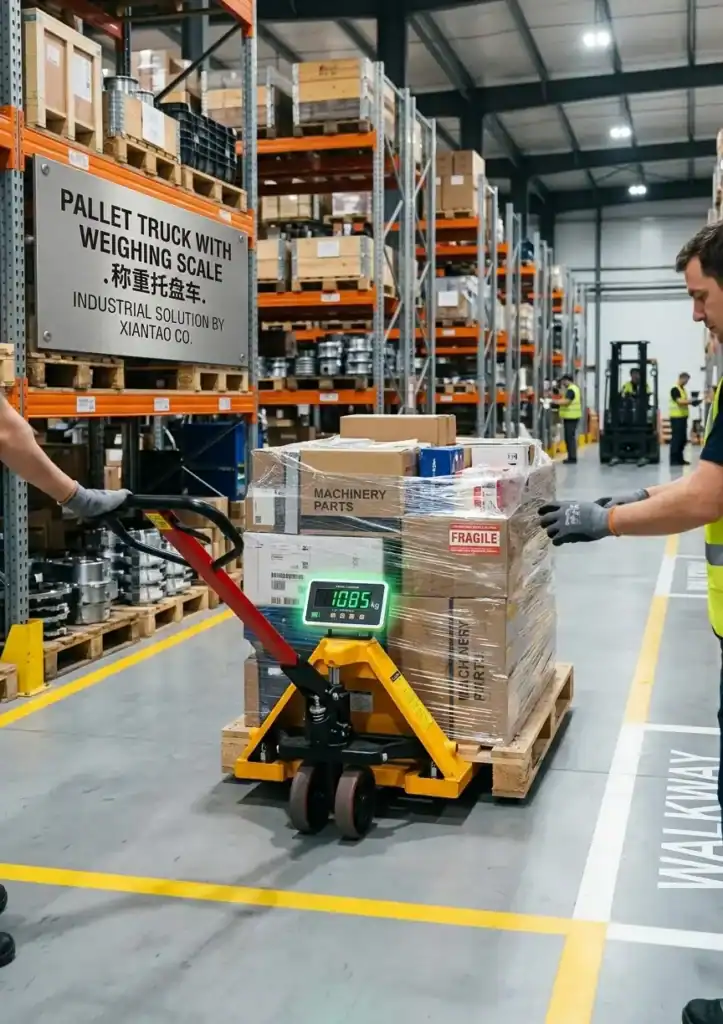
To appreciate where we are, we must look at the evolution of the industrial scale. Early iterations were often cumbersome and prone to inaccuracy if the ground wasn’t perfectly level. Modern pallet trucks with weighing scales utilize advanced strain-gauge load cell technology. Usually, four high-capacity load cells are strategically placed within the fork structure to ensure that even if a load is slightly off-center, the weight remains accurate. These cells convert the pressure of the load into an electrical signal, which is then processed by a digital indicator mounted at eye level for the operator.
The integration of the digital indicator has also seen massive upgrades. Most modern units now feature high-contrast LCD or LED displays, often with IP-rated waterproofing to withstand wash-down environments or dusty warehouses. When you are searching for a high-quality pallet truck with a weighing scale, the quality of the sensor and the shielding of the electronics are the primary factors that separate professional-grade equipment from entry-level tools.
Operational Benefits: Beyond Just a Number
The primary driver for adopting a weighing pallet truck is the immediate reduction in labor hours. When a pallet is picked up, the weight is displayed instantly. This eliminates the “bottleneck at the scale” that often occurs during peak shipping hours. In large-scale manufacturing, this can save dozens of man-hours per week. However, the benefits extend far beyond simple time-saving.
Accuracy in shipping is a critical component of international trade. Overloading a container or a truck can lead to heavy fines and safety hazards, while under-reporting weight can lead to lost revenue through missed shipping charges. By using an on-board scale, operators can verify the weight of every pallet before it hits the trailer. This ensures 100% compliance with SOLAS (Safety of Life at Sea) requirements and other transport regulations without adding a single second to the loading process.
Inventory Management and Parts Counting
Many high-end pallet trucks with weighing scales come equipped with a “parts counting” feature. This is an invaluable tool for businesses dealing with high volumes of uniform components, such as automotive parts or industrial fasteners. Instead of manually counting thousands of items, an operator can establish the weight of a single unit (the “sample weight”) and then let the scale calculate the total quantity based on the pallet’s mass. This transforms a simple transport tool into a mobile inventory management station, allowing for rapid stocktakes and audits.
Furthermore, the “totalizing” function allows operators to add up the weights of multiple pallets to calculate the total weight of a shipment or a specific order. This data can often be printed directly from an optional on-board thermal printer or transmitted via Bluetooth or Wi-Fi to a central Warehouse Management System (WMS). This digital bridge ensures that the physical world of the warehouse stays perfectly in sync with the digital world of your inventory records.
Selecting the Right Capacity and Fork Dimensions
When sourcing a pallet truck with a weighing scale, the “one size fits all” approach rarely works. Most standard industrial units offer a capacity of 2000kg (approx. 4400 lbs), which covers the vast majority of palletized goods. However, for heavy-duty industries like steel fabrication or stone processing, 2500kg or 3000kg models may be necessary. It is crucial to choose a capacity that exceeds your heaviest expected load to avoid straining the hydraulic system and the sensitive load cells.
Fork dimensions are equally important. While the “standard” 540x1150mm or 685x1220mm forks work for Euro and US pallets respectively, specialized industries may require low-profile forks or extra-long forks. A weighing scale adds a slight amount of height to the forks, so if you are working with disposable pallets or crates with very low entry points, you must verify the “minimum lowered height” of the truck to ensure it can still slide under the load without damage.
Power Systems: Internal Batteries and Charging
Since the weighing system is electronic, it requires a consistent power source. Most units utilize an internal rechargeable battery, typically a lead-acid or a more modern lithium-ion pack. For light usage, a standard battery might last a full week of intermittent weighing. However, in high-intensity 24/7 operations, lithium-ion technology is preferred due to its ability to handle “opportunity charging” during break times without degrading the battery life.
A critical feature to look for is the “auto-sleep” or “power-save” mode. Since operators often forget to turn off the scale after moving a load, an intelligent indicator that dims the screen or shuts down after five minutes of inactivity can significantly extend the time between charges. For the most demanding environments, some models even offer swappable battery packs, allowing the truck to stay in constant motion while a spare battery charges in a desktop cradle.
Durability and Environmental Protection
A warehouse is a punishing environment. Pallet trucks are subjected to impacts, vibrations, and temperature fluctuations. When the truck houses a sensitive weighing scale, durability becomes a multi-layered concern. Look for a chassis made of reinforced steel with high-quality powder coating to prevent corrosion. The hydraulic pump—the heart of the lifting mechanism—should be a heavy-duty, cast-iron design rather than a light-duty stamped version.
The load cells themselves must be protected from “shock loading.” A good weighing pallet truck will have mechanical stops or a specialized mounting system that prevents the load cells from being crushed if a heavy pallet is dropped onto the forks too quickly. Additionally, if your facility deals with chemicals, food products, or high humidity, choosing a stainless steel pallet truck with a weighing scale (or at least a galvanized version) is essential to prevent rust and meet hygiene standards.
The Role of Calibration and Accuracy Standards
No scale is useful if it isn’t accurate. In the context of a pallet truck, accuracy is typically expressed as a percentage of the applied load (e.g., +/- 0.1% of the total weight). For most internal inventory checks, a high-quality industrial scale is sufficient. However, if you are “selling by weight”—meaning the price of the goods is directly determined by the scale reading—you may need a “Legal for Trade” or “NTEP Approved” version.
Regular calibration is part of the maintenance lifecycle. Over time, vibration and heavy usage can cause a slight drift in the sensors. Most digital indicators allow for easy recalibration using a known test weight. For businesses focused on ISO certification or high-level quality control, documenting these calibration intervals is a key part of maintaining operational integrity and customer trust.
Real-World ROI: Calculating the Payback Period
Investing in a pallet truck with a weighing scale is more expensive than buying a standard manual pallet jack. However, the Return on Investment (ROI) is often achieved in less than six months. To calculate this for your own business, consider the number of pallets moved per day. If moving a pallet to a stationary scale takes an extra 3 minutes, and you move 40 pallets a day, you are losing two hours of labor daily. At an average warehouse wage, that loss quickly surpasses the cost difference of the equipment.
Beyond labor, consider the cost of “re-weigh fees” from shipping carriers. If a carrier finds a discrepancy between your declared weight and the actual weight, they often apply significant surcharges. By using a weighing pallet jack to verify every outgoing shipment, you eliminate these “hidden” costs, directly impacting your bottom line.
Conclusion: Integrating Mobile Weighing into Your Strategy
The pallet truck with a weighing scale represents the shift toward “smart” material handling. It is no longer just about moving an object from point A to point B; it is about capturing data at every touchpoint. By integrating measurement into the transport phase, businesses reduce errors, increase safety, and maximize the efficiency of their workforce.
Whether you are managing a small workshop or a massive export hub, the move to mobile weighing is a logical step in the journey toward lean operations. When selecting your equipment, prioritize the quality of the load cells, the robustness of the frame, and the clarity of the digital interface. In doing so, you aren’t just buying a tool—you are upgrading the very intelligence of your supply chain. As the B2B landscape becomes increasingly data-driven, those who can accurately weigh, track, and move their inventory with the highest speed will be the ones who lead the market.
 English
  German
  Spanish
  French
  Portuguese
  Japanese
  Hindi
Hindi  Urdu
Urdu  Chinese

